
1xBet Casino Review
Best For: Experienced players who transact exclusively in cryptocurrency, who understand what a second-tier licence does and does not protect, and who treat their balance as money they can afford to lose entirely. Anyone intending to withdraw in Philippine pesos should read the payment section before depositing anything.
1xBet does hold a valid second-tier licence — we confirmed it in the Curaçao regulator's own public register. What that licence does not tell you is that the company holding it replaced a predecessor the Dutch Supreme Court declared bankrupt specifically for refusing to pay player winnings, using the same payment infrastructure. It also holds no Philippine authorization and is blocked there at ISP level. Player reports from 2025–2026 describe a consistent pattern: deposits clear in seconds, while peso withdrawals through GCash and Maya are reported to take from three days to over three weeks, with some marked "successful" but never arriving.
Based on our analysis conducted September 2026, drawing on PAGCOR, CEZA and Curaçao Gaming Control Board registries, Philippine Senate and NTC/CICC records, and player reports collected across Trustpilot, AskGamblers, Casino.Guru, Reddit and Philippine Facebook communities from 2025 to 2026. No Gaming Lab payout testing was conducted on this platform.
Licensing: The Licence Is Real — and It Is Held by the Successor to a Company Bankrupted for Not Paying Winners
1xBet holds a genuine, independently verifiable second-tier licence, and the reason that matters less than it sounds is the corporate history attached to the company holding it.
The Gaming Lab checked the licence directly against the Curaçao regulator's own published register of online gaming licences rather than taking the operator's word for it. The entry is there: licence OGL/2024/1262/0493, held by Caecus N.V. as a B2C licensee, listed with indefinite duration. We also checked the regulator's separate enforcement register, which records revoked and non-extended licences — neither Caecus N.V. nor its predecessor appears among those entries. On the narrow question of whether this operator is licensed somewhere, the answer is yes, and any review claiming otherwise is wrong.
One discrepancy is worth noting. The platform's own terms state the licence was granted on 7 November 2024, while the regulator's register carries a date of 24 December 2025 against the entry. That gap of more than a year is unexplained, and we were unable to establish whether it reflects a re-issue under the transitional framework or a documentation inconsistency.
It is also worth being precise about what a Curaçao licence is. It sits a tier below the credentials that impose meaningful player-fund segregation and independent dispute adjudication, and it obliges the holder to respect the laws of the jurisdictions where its players actually live rather than granting any right to override them. It is a floor, not a guarantee — and the floor is where this operator's regulatory standing sits.
The corporate history underneath that credential is where the substantive concern sits, and it has nothing to do with any particular market. 1xBet's original operating company, 1X Corp N.V., was the subject of a class action brought on behalf of players who said the company froze their accounts, disputed their identity documents, and refused to pay legitimate winnings. A Curaçao court declared it bankrupt in November 2021; the appeal court upheld the ruling in May 2022; and the Dutch Supreme Court rejected the operator's final appeal in January 2023. The appointed liquidator reported that the entity was uncooperative and additionally owed over €1.3 million in unpaid Curaçao taxes. The brand's domains, intellectual property and player databases then moved to a newly incorporated company while the same Cyprus-registered payment agents continued processing the money — a pattern regulators generally call phoenixing. Separately, the UK Gambling Commission revoked the brand's licence in 2019 following an investigation into its advertising and betting practices, and the Government of Gibraltar has stated that Techinfusion Limited, named in some of the brand's administrative claims, holds no authorization for remote gambling there.
A court-confirmed bankruptcy for non-payment of winnings is the single most relevant fact in any licensing assessment, because it is the exact failure mode a licence is supposed to prevent. It is not a jurisdictional technicality and it does not expire when the company changes its name.
Market Legality: 1xBet Is Blocked and Unauthorized in the Philippines
Readers in the Philippines should know that 1xBet holds no Philippine gambling authorization of any kind and is subject to active ISP-level blocking there, regardless of what its Curaçao credential says.
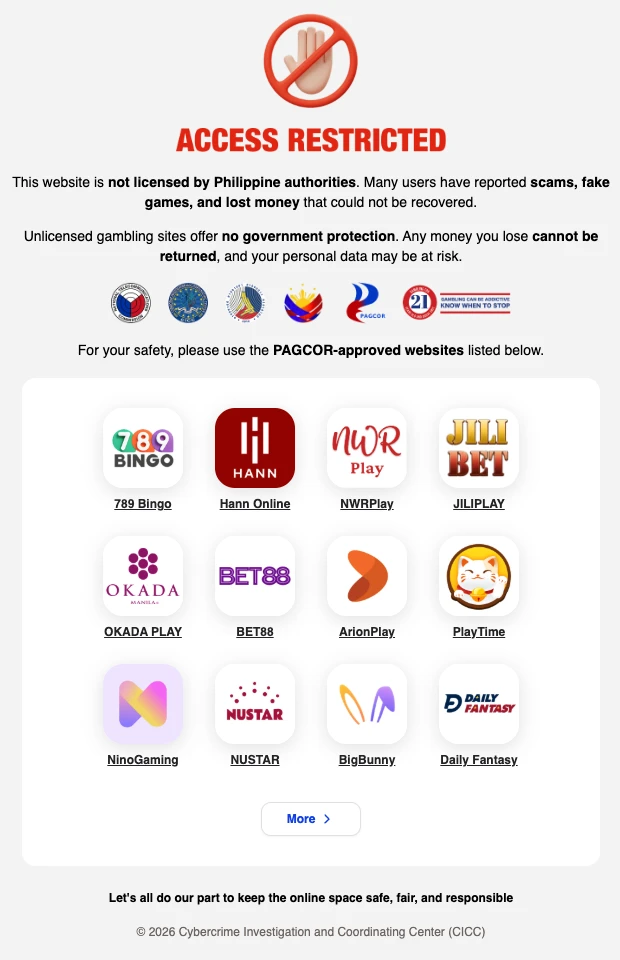
The Gaming Lab cross-referenced the brand and its operating companies against PAGCOR's list of accredited gaming system administrators and registered domains, the register of Internet Gaming Licensees, the Cagayan Economic Zone Authority's interactive gaming licensee list, and the Philippine Inland Gaming Operator framework. Neither the brand nor Caecus N.V. nor its bankrupt predecessor appears on any of them. Philippine institutions have said so publicly: at a Senate Games and Amusement Committee hearing in September 2025, the president of the national volleyball federation confirmed that 1xBet logos were blacked out of domestic broadcasts of the FIVB World Championship because the brand is illegal in the country and PAGCOR had restricted its logos in advance. A title sponsorship with a domestic basketball league, signed to run through 2026, was cancelled mid-season. Philippine ISPs now redirect blocked gambling domains to a government interstitial page warning that the site is unlicensed and that lost funds cannot be recovered, and the operator responds by rotating to mirror domains.
The practical consequence for a Filipino player is that there is no domestic regulator to escalate to, no local corporate entity to pursue, and — because deposits typically route through offshore payment agents or informal local intermediaries — no realistic route for asset recovery. We treat this as a market-specific risk disclosure rather than a factor in the platform's global rating, but for readers in that market it is the most consequential paragraph in this review.
Payment Experience: Frictionless Going In, Adversarial Coming Out
1xBet's payment architecture is optimised for capital inflow and exhibits documented, systemic resistance to peso outflow — a pattern reported consistently enough across independent complaint platforms that it should be treated as a structural characteristic rather than a run of bad luck.
The platform advertises e-wallet withdrawals completing within zero to twenty-four hours. What players report is materially different, and the gap is not uniform across payment rails:
| Method | Platform-advertised | Player-reported reality (2025–2026) | Most cited cause |
|---|---|---|---|
| USDT / Bitcoin | 15 minutes | 1–24 hours | Routine review, chain congestion |
| GCash / Maya | 0–24 hours | 3–25 days | "Payment method unavailable", third-party API failure, withdrawals marked complete that never arrive |
| Local bank transfer | 3–5 days | 7–30+ days | Account-detail mismatches, extended security review |
| Credit / debit card | 3–7 days | Frequently declined | Same-method-as-deposit enforcement |
The most serious recurring report is what Philippine players have taken to calling a ghost withdrawal: the platform marks the transaction successful, deducts the amount from the casino balance, and the money never lands in the GCash or Maya account. One widely circulated case involved a ₱16,000 withdrawal where the player supplied a transaction-history PDF and a screen recording of the receiving wallet, and their bank reported it could not locate the reference number the casino had issued. In that pattern the funds sit in limbo rather than being auto-reversed to the gaming balance, which is what a PAGCOR-regulated operator is required to do, and the burden of proof lands entirely on the player.
Crucially, cryptocurrency withdrawals are widely reported as fast and reliable. That matters analytically: it tells us the operator has the liquidity to pay. The bottleneck is specific to the peso rails that ordinary Filipino players actually use, which is the opposite of what a liquidity problem looks like.
A second friction point is the closed-loop rule. Anti-money-laundering practice generally requires withdrawing through the method used to deposit, and that rule is unremarkable in itself. What players report is that the original deposit method later disappears from the withdrawal menu, after which support instructs them to make a further deposit through a new method in order to "verify" it — asking a player to increase their exposure to the platform in order to recover money already on it.
Underneath all of this sits the agent layer. Because the operator cannot hold a corporate bank account in the Philippines as an unlicensed entity, a large share of Philippine deposits never touch an official cashier at all. Players send pesos by GCash to a local agent's personal number, and the agent credits equivalent casino balance. If that agent disappears, there is no corporate counterparty and no Philippine regulator to escalate to — a structural exposure that no amount of platform-side customer service can resolve.
Payment Experience is the weakest dimension in our 1xBet assessment — see the radar chart above for how far it sits below everything else. This is the dimension that decides whether a gambling platform is usable at all, and it is the one where the documented evidence against this operator is heaviest.
The Bonus Structure: The Accumulator Rule Matters More Than the Headline Percentage
1xBet's welcome offer is generous on paper and, for the sports bonus, mathematically structured so that most players will never convert it into withdrawable money.
The casino side carries a stated 40x turnover requirement, which sits in the unfavourable-but-recognisable range for this market. The sports welcome bonus is where the design becomes unusual. Rather than a straight rollover, the bonus must be wagered five times, and those wagers must be placed exclusively in accumulators of at least three events, with every leg carrying odds of 1.40 or higher. A three-leg accumulator at exactly 1.40 per leg produces combined odds of roughly 2.74 — an implied win probability of about 36% before any bookmaker margin. Requiring that to land five times over is not a wagering requirement in the ordinary sense; it is a structure whose expected outcome is that the balance is lost first.
Two further terms compound this. Activating any bonus locks the player's real-money balance alongside the bonus balance, so a player who accepted a promo code at registration — several are circulated widely by Philippine influencers — can find their own deposit unwithdrawable. And cancelling an active bonus to release the deposit forfeits every peso of winnings accumulated during that period. Both terms are disclosed inside dense terms and conditions and are legally defensible; both are also, predictably, the largest single source of "1xBet won't pay me" accusations in Philippine Facebook groups, where casual bettors drawn in by promises of free money have no reason to understand parlay mathematics.
Game Library: The One Dimension That Genuinely Delivers
The breadth of 1xBet's game and sports catalogue is real, substantial, and the only dimension of this platform that competes at the top of the market.
The slots roster runs through JILI, PG Soft, Fa Chai, Endorphina, Kalamba Games, Winspinity and a long tail of smaller studios, while the live dealer floor carries Evolution, Pragmatic Play, Ezugi, SA Gaming and TVBet alongside the operator's proprietary 1xLIVE tables. The sportsbook is the platform's genuine flagship, covering an unusually deep set of leagues and esports markets, and the in-house 1xGames suite provides crash, fishing and instant-win formats that many Philippine-facing competitors lack. There is no cockfighting product, which is a notable local gap, but almost nothing else is missing.
One qualification prevents this dimension from scoring higher. Because the platform operates outside PAGCOR's technical-audit regime, there is no Philippine-verifiable RNG certification, and results of any testing conducted under the Curaçao framework are not published. Players are asked to take game fairness on trust from an operator whose disclosure record does not support that trust elsewhere.
Game Ecosystem is the strongest dimension in our 1xBet assessment by a wide margin — see the radar chart above for how isolated that strength is. A large catalogue is a reason to want to play somewhere. It is not a reason to believe you will be paid.
What Real Players Are Saying About 1xBet in the Philippines
Public sentiment on 1xBet is not merely mixed — it is bimodal, and the shape of that split is itself the most informative signal in the dataset.
On aggregate review platforms the brand holds almost exclusively five-star and one-star ratings with very little in between. The one-star reviews are detailed, emotionally consistent, and frequently carry specific ticket numbers, exact amounts and dated transactions, which is what authentic complaint documentation looks like. They cluster around the same four themes throughout 2025 and 2026: blocked peso withdrawals, extended verification with no resolution, promotional terms locking deposited funds, and support that stops responding once money is meant to flow outward.
The five-star reviews break down into three identifiable groups. Cryptocurrency users report genuinely smooth experiences, which is technically accurate and entirely unrepresentative of the GCash-using majority. Affiliates and agents, who earn a share of recruited players' net losses, have a direct financial incentive to post positive testimonials and referral codes. And a portion appears to be incentivised feedback exchanged for small account credits. Read that way, the polarisation is not a mystery about product quality; it is a map of which side of the platform's payment architecture the reviewer sits on.
The verification process is where the most consistent frustration accumulates. Players describe depositing with essentially no identity checks, then encountering escalating documentation demands only once a substantial withdrawal is requested — identity documents rejected for lighting or cropping, selfies holding an ID next to an open support chat, notarised utility bills that cost money to obtain, and bank statements stamped at a branch. Follow-ups are met with automated replies stating that requests are handled in the order received. One player's complaint after roughly two months of this reads simply that the response is no longer acceptable. We describe this as a documented pattern of player reports, not as a proven intent; but the pattern's consistency across independent arbitration platforms is what a reader needs to weigh.
Two further risks belong here because they fall outside the platform entirely. Philippine Android users cannot install the app from Google Play and must sideload an APK, which trains users to disable a core device security control — and counterfeit 1xBet APKs bundled with credential loggers and SMS forwarders circulate widely in Telegram and Facebook groups. Separately, when players complain publicly about trapped funds, accounts posing as platform investigators approach them offering to release the money for an unfreezing fee. Neither of these is something the operator can be blamed for directly. Both are predictable consequences of distributing a product through unregulated informal channels.
Player Protection: A Thorough Policy Page, Two Working Tools
1xBet publishes more responsible gambling policy text than most Philippine-facing platforms, including a self-assessment questionnaire for problem gambling — and then makes the two tools it does offer harder to reach than they should be.
Deposit and stake limits exist, and self-exclusion exists with durations from one month up to five years. That is more than many competitors in this market provide. The important qualification is that neither is a self-service toggle inside the account: both are activated by emailing a dedicated address, with the operator processing the request, and stake-limit changes take effect only twenty-four hours after submission. A player in the middle of a difficult session needs a control they can reach in three taps, not a support ticket.
Cooling-off periods, session-time reminders and play-history reminders were not found on the platform. Neither were links to any external support service — no BeGambleAware, no GamCare, and no route to PAGCOR's own self-exclusion portal, which is the resource actually relevant to a Filipino player. The policy text describes the harms of problem gambling accurately and at length. The functional gap between describing those harms and giving players a working means of managing them is the distance this dimension is measuring.
Responsible Gambling Reminder
Gambling carries real financial risk and should always be treated as entertainment, never as a source of income or a way out of financial pressure. Never gamble with money needed for essential living expenses, and never increase your stakes to chase losses.
If you or someone you know is struggling with gambling-related harm, free and confidential support is available. In the Philippines, PAGCOR operates a self-exclusion programme at osea.pagcor.ph, and Gamblers Anonymous Philippines can be reached at gaphilippines.com. International support is available 24/7 through GamCare (gamcare.org.uk) and BeGambleAware (begambleaware.org).
The Bottom Line: A World-Class Catalogue With No Working Complaint Channel
The question worth asking about 1xBet is not whether the games are good — they are, comfortably — but whether the money comes back, and on that question the licensing position and the payment record point the same direction.
What this operator offers is genuine scale: one of the deepest sportsbooks anywhere, a slots and live floor stocked with studios most competitors cannot assemble, and crypto withdrawals that players consistently report as fast and reliable. That combination is real value, and dismissing it would be dishonest.
What it does not offer is a functioning route to recourse. The licence is real, but it is a second-tier credential carrying none of the fund-segregation or independent adjudication that a player would actually need — and the company holding it replaced a predecessor that a supreme court declared bankrupt precisely for refusing to pay winners, using the same payment infrastructure. Bonus terms lock a player's own deposit, and cancelling to escape that lock forfeits everything won. And the payment record — deposits instant, peso withdrawals reported at three days to three weeks, verification demands surfacing only after a win — describes an operation that is comfortable holding your money for as long as it takes for you to stop asking.
A narrow profile does make sense here: an experienced player transacting only in stablecoins, claiming no bonuses, and treating the balance as fully expendable. Almost everyone else is taking a risk they have not priced. If you are in the Philippines, add to that a platform blocked at ISP level with no domestic regulator to escalate to, and the case becomes considerably harder to make.
See the radar chart above for the complete five-dimension picture. The shape of it is the argument: one strong dimension, one very weak one, and no mechanism by which the strong one protects you from the weak one. Fully licensed alternatives exist in most markets this brand serves, and several are reviewed elsewhere on this site.
Sources & Verification
The regulatory findings in this review were checked against the following primary sources. The third-party review platforms referenced in the player-experience section are described in context above and are not listed here.
- PAGCOR, List of Accredited Gaming System Administrators and Registered Brands and Domain Names/URLs — searched for 1xBet, Caecus N.V. and 1X Corp N.V.; no entry found (list dated 27 August 2026; checked [2026.09.11])
- PAGCOR, register of Internet Gaming Licensees — searched; no entry found (checked [2026.09.11])
- Cagayan Economic Zone Authority, interactive gaming licensee list — searched; no entry found (checked [2026.09.11])
- PAGCOR, Philippine Inland Gaming Operator accreditation — no accreditation held (checked [2026.09.11])
- Curaçao Gaming Authority, register of online gaming licences — licence OGL/2024/1262/0493, Caecus N.V., B2C, listed with indefinite duration (register dated 8 September 2026; checked [2026.09.11])
- Curaçao Gaming Authority, enforcement register — no entry for Caecus N.V. or 1X Corp N.V. (register dated 10 July 2026; checked [2026.09.11])
- Supreme Court of the Netherlands, ECLI:NL:HR:2023:50, 20 January 2023 — bankruptcy of 1X Corp N.V. (checked [2026.09.11])
- ABS-CBN News, report on the Philippine Senate Games and Amusement Committee hearing, 16 September 2025 (checked [2026.09.11])
- 1xBet Terms and Conditions, KYC Policy and Responsible Gambling pages (operator-published; checked [2026.09.11])
